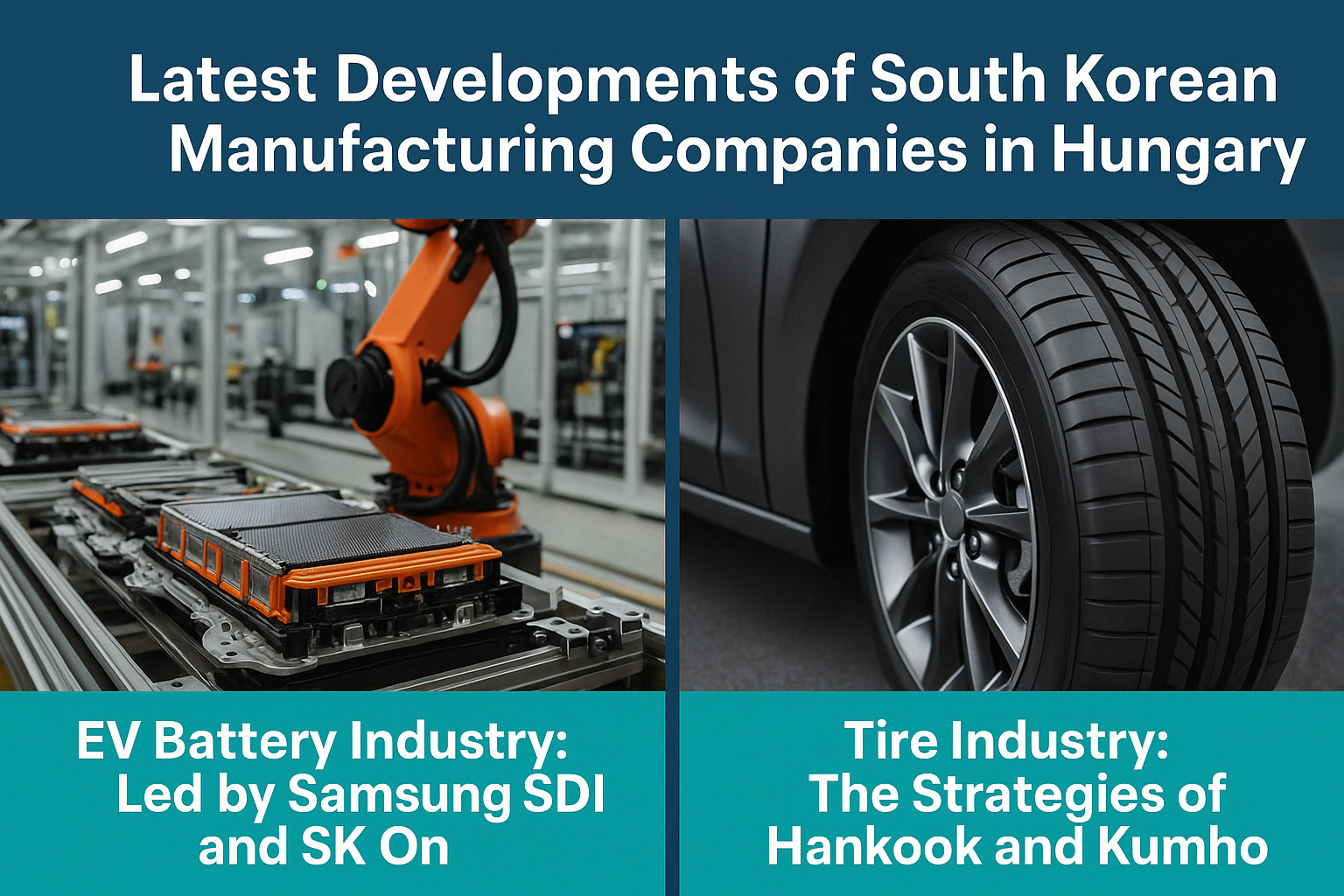
EV Battery Industry: Led by Samsung SDI and SK On
South Korean manufacturers continue to view Hungary as a major European hub for EV battery production and are actively expanding their investments. Samsung SDI operates a large-scale automotive battery plant in Göd, near Budapest. Since its establishment in 2017, the plant has undergone multiple expansion phases with total investment exceeding €1.3 billion (₩2 trillion) . Its current annual production capacity has reached approximately 40 GWh, enough to power about 600,000 mid-size EVs , making it one of Samsung SDI’s most important battery supply bases for the European market.
In 2025, the company began upgrading and expanding its production lines, introducing high-performance prismatic batteries for Hyundai and Kia vehicles . Samsung SDI raised approximately ₩1.65 trillion (€1.05 billion) in May 2025 , with part of the funds allocated to refurbish its first plant and expand its second one . By 2026, the total production capacity is expected to double to 60 GWh per year. Moreover, the company has signed a long-term supply contract with Hyundai and Kia, under which it will supply 6th-generation NCA stack-type cells from 2026 to 2032—enough for roughly 500,000 vehicles —thereby strengthening its supply network for Europe’s fast-growing EV market.
Meanwhile, SK On is rapidly expanding its footprint in Hungary. The company established two battery plants in Komárom, where mass production for EV and hybrid batteries began in 2020. Initially designed for 7.5 GWh per year, the combined capacity has since increased to around 16 GWh. In 2021, SK On announced its third factory, located in Iváncsa, central Hungary—a massive project with an estimated investment of ¥272.4 billion (€1.9 billion) and a site covering 700,000 m² . Commercial production began in late 2024, and within just three months, the plant achieved a production yield above 90%, far faster than typical industry ramp-up times . With an annual capacity of 30 GWh, equivalent to 430,000 EVs with 400 km range, SK On’s total European output has now expanded to 47.5 GWh . The plant is so central to Iváncsa’s economy that the road in front of it was renamed “SK út (SK Road)” .
Korean battery material suppliers are also strengthening the local supply chain. Inzi Controls established its first European plant in Komárom in 2019, investing €45 million to produce EV battery modules. Lotte Aluminium, a subsidiary of Lotte Group, opened an aluminum foil plant in Tatabánya in 2021 with an investment of €133 million, producing anode current collectors for EV batteries and creating 107 jobs. Similarly, Solus Advanced Materials (formerly part of Doosan Group) operates Europe’s only electrolytic copper foil plant in Tatabánya, where the second phase began operation in 2023. The two factories together produce over 20,000 tons of copper foil annually, supplying major cell makers such as CATL and Samsung SDI.
Additionally, LG Chem, in a 50:50 joint venture with Japan’s Toray, established LG Toray Hungary Battery Separator Kft. in Nyergesújfalu in 2022, producing separator films for automotive batteries. In the cathode materials sector, EcoPro BM began construction of its first European plant in Debrecen in April 2023, investing $290 million . The plant, scheduled for completion in 2025, will produce 108,000 tons of cathode materials annually, enough for 1.4 million EVs .
Together, these projects demonstrate how South Korea has built a comprehensive EV battery ecosystem in Hungary—from electrode materials and components to full cell manufacturing—establishing a stable supply base for European automakers.
Tire Industry: The Strategies of Hankook and Kumho
South Korea’s tire makers are also prominent in Hungary. Hankook Tire operates a major factory in Rácalmás, near Dunaújváros, which has been producing since 2007. The plant manufactures around 17 million tires annually for passenger vehicles across Europe and employs approximately 3,000 people. In 2025, Hankook began a €540 million expansion project—the fourth phase since its launch—to boost commercial vehicle tire capacity . Upon completion in 2027, the factory will produce up to 800,000 truck and bus tires annually, creating 450 new jobs . This expansion strengthens its flexibility in serving Europe’s diverse tire market while reducing logistics costs.
Meanwhile, Kumho Tire, South Korea’s second-largest tire manufacturer, announced plans to build its first European factory by 2027, investing over ₩1 trillion (€750 million) . The facility is expected to produce 12 million tires per year, mainly for high-performance EV applications . The final site has not yet been confirmed, but Hungary remains a strong contender among the shortlist, which includes Romania, Serbia, and Portugal . Hungarian authorities have expressed active interest in hosting the plant, which would complement Hankook’s presence and expand Hungary’s tire industry cluster.
Automotive Components: Hanon Systems and LG Magna
Although Hyundai and Kia do not have car assembly plants in Hungary, a network of Korean automotive component suppliers has flourished. Hanon Systems, a leader in automotive thermal management systems, has operated in Hungary since the 1990s and now runs major plants in Székesfehérvár, Rétság, and Pécs. The Székesfehérvár site has served as Hanon’s key European hub, supplying compressors and cooling modules for global automakers for over 30 years.
To meet rising demand for EV-related cooling systems, Hanon built a new fluid management plant in Pécs in 2021 (22,000 m², over 300 employees) and expanded its aluminum die-casting operations in Rétság (4,500 m², 150 employees). These upgrades significantly increased Hanon’s European production capacity. The company emphasizes that its investments aim to “contribute to decarbonization innovation while growing in harmony with local communities.”
In September 2023, LG Magna e-Powertrain, a joint venture between LG Electronics and Magna International, announced the construction of its first European production site in Miskolc at the IAA Mobility show in Munich . The €51.6 million facility (26,000 m²) is scheduled for completion in 2025, initially producing electric drive motors before expanding to inverters and on-board chargers . The project will create about 200 jobs and serve major European automakers.
Other suppliers are also expanding. Bumchun Precision, a metal component manufacturer, operates a factory in Salgótarján and announced in early 2025 a €56 million expansion, adding four new production lines and creating 400 jobs . The Yura Corporation, a major wire harness producer, maintains multiple plants in Hungary supplying electrical systems to European OEMs—a presence dating back to the 1990s.
Electronics: Samsung’s Longstanding TV Plant
Korean electronics manufacturers have long been part of Hungary’s industrial landscape. The most prominent example is Samsung Electronics, which operates a TV assembly plant in Jászfényszaru, about 70 km east of Budapest. Opened in 1989, it was one of the earliest Korean manufacturing facilities in Central and Eastern Europe. Over 30 years, the plant has produced more than 100 million units of televisions , maintaining its position as one of Europe’s largest TV factories.
In recent years, Samsung has invested $450 million to modernize production lines for 4K and 8K smart TVs and large-format displays . Employing around 2,500–3,000 workers, the plant ships millions of units annually across Europe. Samsung Electronics Hungary has been recognized as a “Strategic Partner Company” by the Hungarian government and participates in national R&D projects. For instance, its Göd R&D Center, established in 2023 with a €56 million investment, focuses on next-generation battery technologies.
Food and Light Industry: CJ CheilJedang and Others
Korean investment extends beyond heavy industry into food and consumer goods. CJ CheilJedang, South Korea’s largest food manufacturer, is building its first Central and Eastern European food factory in Dunavarsány, south of Budapest . The €80 million project covers 14,000 m² and will produce frozen Korean foods such as mandu (dumplings) and K-style fried chicken for the European market . Scheduled to open in late 2026, the factory will employ about 200 people, sourcing most ingredients locally in Hungary. Supported by a multi-billion-forint government subsidy, the project is expected to enhance Hungary’s food industry value chain.
Meanwhile, several smaller Korean firms have entered Hungary’s textile, cosmetic, and aluminum-processing sectors. In October 2024, a Korean aluminum parts manufacturer announced a new plant in Maglód, near Budapest, prompting local environmental discussions. The facility, planned within an industrial zone, will process aluminum components for industrial use and create new jobs upon completion.
Conclusion
As of 2025, South Korean manufacturers have established a strong and diversified presence in Hungary, spanning from automotive and batteries to electronics and food production. Some, like Samsung Electronics, have been operating since the late 1980s, while others—SK On, LG Magna, and CJ Foods—represent the latest wave of investment driven by the EV revolution and rising European demand.
South Korea now ranks as the third-largest foreign investor in Hungary , with cumulative investments worth several billion forints and around 20,000 local jobs created. With EV battery expansion projects, tire plant upgrades, and new food manufacturing ventures underway, Hungary has become a strategic gateway for South Korea’s European industrial expansion. Supported by tax incentives and subsidies under Hungary’s national electrification strategy, bilateral economic cooperation is expected to deepen further, solidifying Hungary’s role as a cornerstone of Korean manufacturing in Europe.
References
https://www.electrive.com/2025/05/27/samsung-sdi-paves-way-for-prismatic-batteries-at-hungary-plant/
https://www.businesskorea.co.kr/news/articleView.html?idxno=243179
https://skinnonews.com/global/archives/19511
https://www.globalconstructionreview.com/korean-company-starts-290m-hungarian-battery-plant
https://www.mk.co.kr/en/business/11254317
https://hipa.hu/news/bumchun-expands-its-salgotarjan-plant
https://trademagazin.hu/en/tizenotmillio-samsung-tevet-gyartanak-a-jaszfenyszarui-uzemben
https://hipa.hu/news/cj-foods-chooses-hungary-for-first-central-and-eastern-european-facility