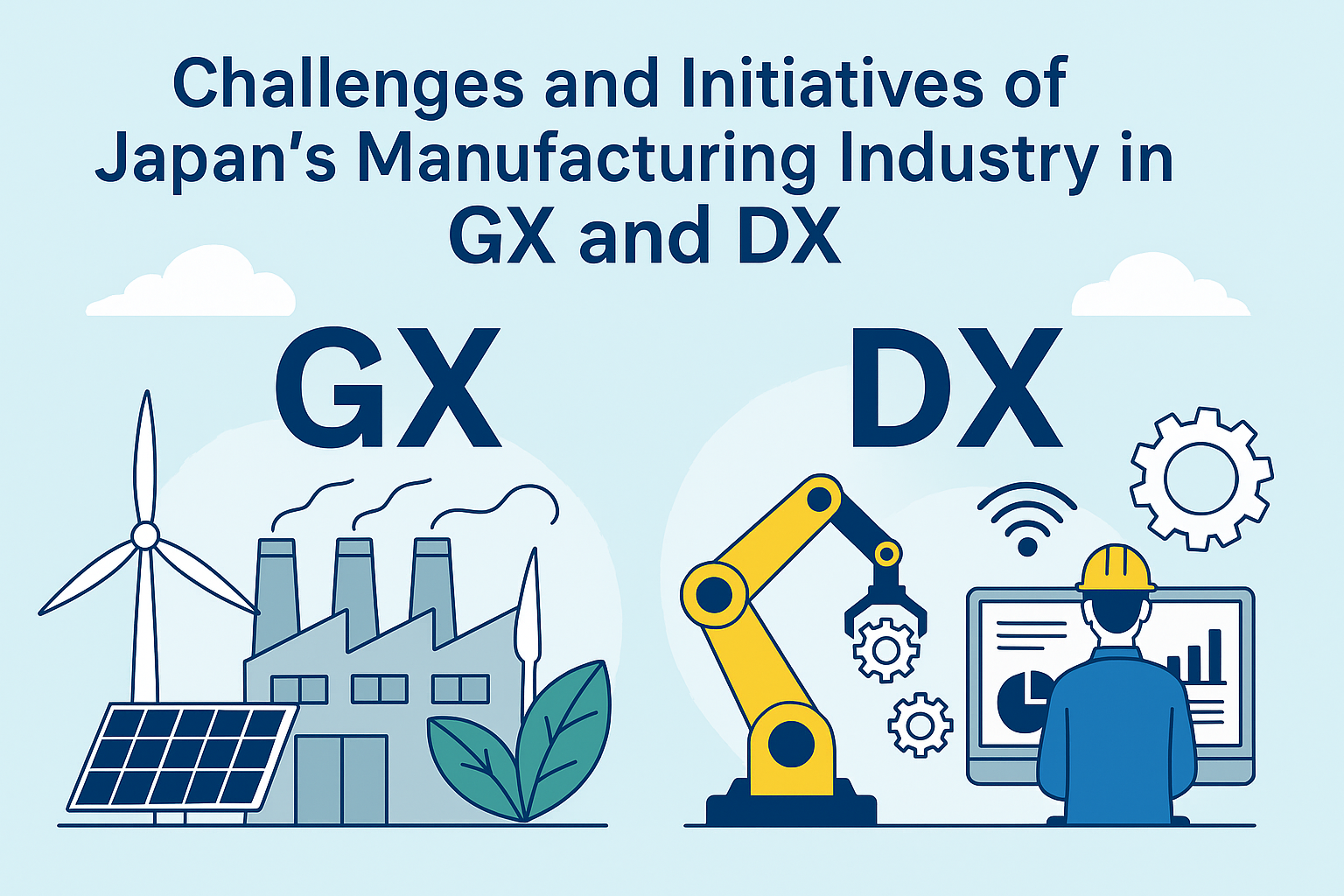
Japan’s manufacturing sector currently faces two major transformational waves: Green Transformation (GX) and Digital Transformation (DX). With carbon neutrality (net-zero greenhouse gas emissions) and enhanced productivity and competitiveness at stake, adapting to GX and DX has become urgent. This article outlines the challenges and solutions of GX and DX in Japan’s manufacturing sector, highlighting specific projects and public-private partnerships being undertaken domestically.
Green Transformation (GX): Decarbonization Challenges and Solutions
GX refers to the shift from carbon-intensive fossil fuels to decarbonized energy sources such as solar, wind, and hydrogen, transforming the entire economic and social system. With the global urgency to tackle climate change, Japan has committed to achieving carbon neutrality by 2050 and is pressing its industrial sector to accelerate GX.
Key Challenges
Heavy industries like steel, chemical, and energy sectors emit significant CO2 due to fossil fuel use. Japanese manufacturers risk incurring massive “carbon liabilities” in the future. Global estimates suggest $42 trillion in carbon costs for the top 1,000 firms by 2050—a burden that falls heavily on manufacturers.
Key Solutions
- Improved Energy Efficiency: Manufacturers are upgrading HVAC systems, optimizing production processes, and recovering waste heat to reduce CO2 emissions.
- Switching to Renewables: Companies like Omron have reduced electricity use by 50% since 2016 by transitioning to renewable energy. Sony aims for 100% renewable electricity by 2030 and has already achieved this at its UK site.
- Hydrogen Energy: Hydrogen is being used in industrial boilers and logistics equipment. Examples include hydrogen-mixed boilers in paper mills and hydrogen-fueled distillation systems in whiskey distilleries.
- Carbon Recycling: ENEOS built a demonstration plant in 2024 to synthesize liquid fuel from CO2 and green hydrogen, with potential applications in transport decarbonization.
Japan’s Green Innovation Fund and the GX League are promoting industry collaboration and R&D for sustainable business creation. GX is viewed not as a cost but as an investment in future corporate value and competitiveness.
GX Success Stories
- Omron: Declared carbon zero by 2050; achieved a 50% reduction in CO2 emissions.
- NTT & NEC: Established a supply chain-wide decarbonization partnership, including renewable-powered procurement and collaborative R&D.
- Sony Group: Under its Green Management 2025 plan, Sony focuses on energy efficiency, renewable energy adoption, and supplier engagement.
- ENEOS Hydrogen Project: Built Japan’s first CO2-to-fuel demo plant, indicating future collaboration opportunities with European stakeholders.
Digital Transformation (DX): Issues and Initiatives in Japan’s Manufacturing
DX involves leveraging digital technologies like AI, IoT, big data, and robotics to transform organizations and improve productivity. For manufacturing, DX means digitizing production lines and linking them to IT systems for business model innovation.
Key Challenges
Japan ranks low in global digital competitiveness (32nd in 2023, according to IMD) and has only three factories listed as “Lighthouses” by the World Economic Forum, compared to 60 from China. Legacy equipment, lack of digital talent, and organizational inertia are key barriers.
Key Solutions
- IoT-Based Visualization: Real-time data from sensors allows quality monitoring and process optimization.
- AI for Quality and Maintenance: Data analytics and AI are used to automate inspections and enable predictive maintenance.
- Digital Twin Simulations: Virtual factory models help with process simulation and remote management.
- Collaborative Robots (Cobots): Enhance human efficiency and reduce labor shortages.
- Intercompany Data Sharing: Toyota has created a shared factory IoT platform to improve cross-facility collaboration.
- Talent Development: Re-skilling programs and DX education initiatives are promoting cultural shifts toward innovation.
GX and DX are interlinked. DX enhances energy efficiency, directly supporting GX goals. In fact, Japan’s Ministry of Economy, Trade and Industry stresses that DX is critical for achieving GX.
DX Success Stories
- Yamaha Motor: Implemented sensors and analytics to reduce defects and move toward unmanned operations.
- Toyota: Developed a company-wide IoT platform enabling real-time factory monitoring.
- Hitachi Omika Works: Named a WEF Lighthouse for cutting lead times by 50% and inventory significantly.
- Omron i-BELT: Offers clients a data-driven solution for factory energy and quality optimization.
- Asahi Tekko (SME): Developed in-house IoT tools, reducing time for part retrieval by 90% and inventory tasks by 64%.
Japan’s manufacturing firms, large and small, are taking steps to meet the challenges of GX and DX. The transformation goes beyond technology—it redefines business processes and organizational culture. With GX and DX seen as complementary forces, Japan is betting on a dual transformation path to remain globally competitive.
Sources (Selected):
- METI (2025), Manufacturing Industry Policy Directions https://www.meti.go.jp/shingikai/sankoshin/seizo_sangyo/pdf/017_03_00.pdf
- MAEJIMA (2025), Understanding GX and DX https://dx-consultant.co.jp/free-lance-gx-dx/
- METI Hydrogen Policy (2024) https://www.meti.go.jp/shingikai/sankoshin/green_innovation/energy_structure/pdf/024_04_00.pdf
- Asahi Shimbun (2024), ENEOS Synthetic Fuel Demo Plant https://www.asahi.com/sdgs/article/15445868
- Smart Factory Research Institute (2025) https://smart-factory-kenkyujo.com/smartfactory-keizaisangyousyou/
- Shannon Blog (2025), Manufacturing DX Overview https://www.shanon.co.jp/blog/entry/manufacturing_dx/
- ITBusinessToday (2025), Industry 5.0 in Japan https://itbusinesstoday.com/ja/industrial-tech/revolutionizing-factory-automation-how-japan-is-achieving-industry-5-0/
Planning a factory project in Europe?
We help companies find partners and engineering support for manufacturing projects in Europe.