Introduction: A New Wave of Manufacturing Investments Attracted by Hungary
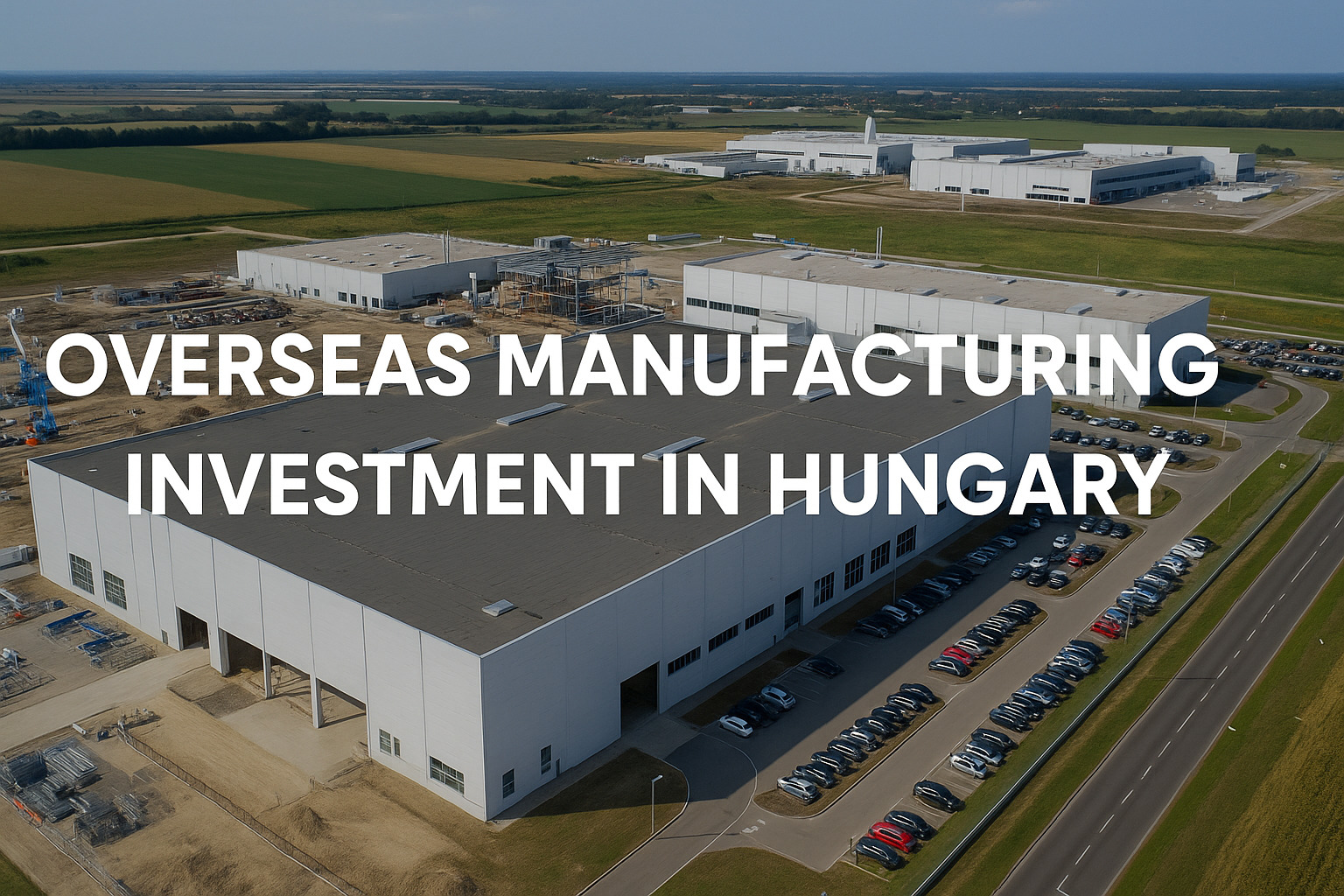
Located in Central Europe, Hungary has in recent years become the site of large-scale investment projects from overseas manufacturers, driven by global supply chain restructuring and Europe’s electrification strategy. Since the start of 2025, announcements of new factories and capacity expansions have continued, particularly in the electric vehicle (EV) sector. These projects come from a wide range of countries including Germany, the United States, the United Kingdom, Switzerland, and Denmark. The Hungarian government has actively promoted foreign investment, offering incentives and signing strategic cooperation agreements to boost job creation and attract high-tech industries, with ambitious initiatives such as the “100 New Factories Program.”
As a result, Hungary is strengthening its position as a European manufacturing hub. The inflow of foreign companies spans a wide range of sectors, from EV batteries and car assembly to railway vehicles, consumer goods, and biochemicals.
The trend of nearshoring in the wake of the pandemic has also been a tailwind. For European automakers and suppliers, Hungary combines geographical centrality with a stable business environment, making local production attractive by reducing logistics costs and lead times. When a German auto parts maker selected Miskolc in northeastern Hungary for a new site, one of the main reasons was proximity to regional customers and the resulting supply chain efficiency. At the same time, in order to meet stricter EU environmental regulations and electrification targets, European and American firms are racing to expand production capacity within the EU, and Hungary is becoming increasingly important as a destination for this growth.
In the following, based on information published since 2025, we summarize major foreign manufacturing projects in Hungary by sector. For each project we highlight the company, country of origin, investment amount, location, expected job creation, and operational timeline, while also discussing the strategic context (EV supply chain reinforcement, nearshoring, EU regulatory compliance, etc.).
Major Investments in Automotive and the EV Supply Chain
Amid the global shift toward electrification, Hungary has seen major investments from European and American automakers into EV production bases. German manufacturers in particular have led the way with both new factories and expansions to existing plants.
- BMW (Germany) – New Debrecen Plant: BMW Group is constructing its state-of-the-art BMW iFactory in Debrecen, eastern Hungary. With a total investment of over €2 billion, the plant is slated for completion and launch of operations by the end of 2025. Pre-series production of prototypes began in 2024, with full-scale mass production to follow in the second half of 2025. The factory will have an annual capacity of 150,000 vehicles, all based on the new “Neue Klasse” EV platform. In addition to vehicle assembly, a high-voltage battery assembly plant will also be integrated on site, streamlining logistics and production. The project will create over 500 new jobs, bringing total employment to around 1,000–1,500. BMW calls the Debrecen site its “most advanced plant in the world,” positioning it as a strategic base in Central and Eastern Europe for the EV era.
- Mercedes-Benz (Germany) – Expansion of EV Line in Kecskemét: Mercedes-Benz is investing over €1 billion in its existing Kecskemét facility to build a new dedicated EV assembly line and expand the body shop. The plant currently employs about 4,500 people, and the investment will modernize and expand capacity while maintaining employment. Mercedes has committed to offering EV variants across its lineup by 2025 and to shift entirely to electric vehicles after 2030. The Hungarian plant will introduce the new MB.EA platform for high-performance EVs from 2025, and from 2024 onward will also take on new compact models based on the MMA platform. The expansion will boost annual capacity to 300,000 vehicles, lifting Hungary’s overall annual car production to around 1 million units. This will make Kecskemét the largest car plant in Hungary’s history, and notably the only site in Europe where a passenger car assembly plant is co-located with a battery factory. This unique integration elevates Hungary’s strategic status as an EV and battery hub for the European auto industry.
- GKN (United Kingdom) – New Driveshaft Plant in Felsőzsolca: UK-based GKN has established a large-scale new manufacturing site in Felsőzsolca, Borsod County (northeastern Hungary). With an investment of over $150 million (~¥20 billion), the plant will produce driveshafts (half-shafts) for regional automotive factories, creating around 1,500 jobs. Although initial operations began in 2023 with 230,000 shafts produced, the plant is on track to reach full capacity of 3 million units annually by 2025. Customers include BMW, Mercedes, Suzuki, and Volkswagen (Audi), all with factories in Hungary. By localizing production that was previously imported from Germany and beyond, GKN is shortening lead times and strengthening the European EV supply chain. Its half-shafts are compatible with ICE, hybrid, and EV vehicles, ensuring long-term relevance.
In addition to these large-scale projects, other German suppliers such as Meleghy Automotive (new body parts plant in Miskolc, $24.2 million, 55 jobs, opening August 2025) and Kirchhoff (expansion of two Budapest-area plants, $53 million, 80 jobs) are also scaling up. These mid-sized investments highlight how Hungary’s incentive programs and labor force support continue to attract European component makers seeking supply chain efficiency.
Diversified Manufacturing Investments Beyond Automotive
Outside the automotive sector, foreign manufacturers are also advancing projects in rail, consumer goods, chemicals, and energy:
- Stadler (Switzerland) – Expansion of Rail Vehicle Plant in Szolnok: Stadler is expanding its Szolnok facility with an investment of $48 million, creating 173 new jobs. The factory will become the company’s largest global production site, outpacing its Swiss and Canadian plants, and meeting growing European demand for railway cars.
- LEGO (Denmark) – Large-Scale Expansion in Nyíregyháza: LEGO is investing $146 million in major packaging and logistics upgrades at its Nyíregyháza plant. The project, running through 2025, will add new packaging halls, warehouses, and offices, increasing floor space by over 30,000 m². Up to 300 new jobs will be created, and the expansion will significantly increase global production capacity.
- Verbio (Germany) – New Green Catalyst Plant in Gödöllő: Verbio subsidiary XiMo is building its first industrial plant in Hungary with a €27.7 million investment. The facility will produce environmentally friendly olefin metathesis catalysts, based on Nobel Prize-winning research, for use in renewable feedstock chemical processes. Scheduled for summer 2026, the plant will employ 40+ high-skilled workers and integrate Hungary into Europe’s sustainable materials supply chain.
- GE Vernova (USA) – Expansion of Power Equipment Plant in Veresegyház: GE Vernova is investing €22.5 million to modernize its gas turbine components facility near Budapest. The plant, GE’s second-largest globally outside the U.S., will add new high-precision machinery, solar panels, and energy-efficient upgrades. The expansion is a response to soaring global demand for power grid stability equipment.
- Emerson (USA) – Expansion of R&D and Engineering Hubs: Emerson announced a €6.2 million investment in 2025 to expand two Hungarian sites, adding 50+ jobs. In Székesfehérvár, the company will hire ~40 engineers for process optimization and customer support, while in Debrecen it will expand its R&D center with 16 engineers focused on automotive measurement and control technologies. Emerson also signed a strategic cooperation agreement with the Hungarian government, reinforcing its long-term commitment.
Conclusion: Hungary’s Strategic Role and Outlook
As seen above, Hungary continues to attract major foreign manufacturing investments across multiple industries, and this momentum has only accelerated since 2025. Companies from Germany, the U.S., the UK, Switzerland, and Denmark are treating Hungary as a strategic European hub, building new plants and R&D centers to respond to shifting markets and regulations. EU environmental rules (such as the 2035 ICE ban), battery regulations, and supply chain restructuring are the strategic drivers behind these moves.
The Hungarian government, through proactive incentives and partnership programs, has helped push annual FDI inflows above €10 billion, a record level. With the twin forces of electrification and sustainability, Hungary is consolidating its role as a front-runner in European manufacturing.
Sources:
https://hipa.hu/news/GE_Vernova-investment-HIPA-Hungary
https://hipa.hu/news/Emerson-Hungary-investments-HIPA
https://businessfacilities.com/three-companies-to-invest-over-320m-in-hungary
https://insideevs.com/news/741832/neue-klasse-electric-suv-production
https://dailynewshungary.com/major-multinationals-investments-2025/
https://dteurope.com/business/stobag-group-largest-manufacturing-base-in-hungary/
https://hipa.hu/news/german-biotech-firm-Ximo-first-plant-in-Hungary-HIPA