1. Global Market Trends (Capacity, Shipments, Revenue, Growth Rate)
As of 2025, the global EV battery market continues its rapid expansion. In 2024, global demand for EV batteries reached approximately 1.0 terawatt-hours (TWh), a 25% year-over-year increase driven by rising electric vehicle (EV) sales. In the first half of 2025 (January–June), total EV battery installations globally reached 504.4 gigawatt-hours (GWh), marking an impressive 37.3% year-on-year growth. This robust demand surge has significantly boosted shipment volumes for leading battery manufacturers compared to the previous year.
While capacity-based growth remains strong, revenue growth has been relatively moderate. This is largely due to a sharp decline in battery prices, driven by oversupply in raw materials. In 2024, the average battery pack price dropped by 20% year-over-year. As a result, the global EV battery market size in monetary terms is estimated at $69.2 billion in 2024 and projected to grow to approximately $77.0 billion in 2025, representing around 11% growth. Despite sustained demand expansion, price pressure is expected to limit the market’s revenue CAGR (compound annual growth rate) to around 6% over the coming years.
Regional demand trends remain dynamic. In 2024, battery demand in China and the United States grew by over 30% and 20% respectively, while demand within the European Union plateaued. China still accounts for nearly 60% of global demand, but this share is expected to fall below 50% by 2030. Demand in emerging markets has shown rapid growth, with Southeast Asia and India doubling their global share from 2% in 2022 to around 5% in 2024. Over the next few years, demand in Europe and other developed regions is also expected to rise, driving further geographic diversification of the global battery market.
According to SNE Research, global EV battery installations in the first half of 2025 surged 37.3% year-over-year, underscoring sustained high growth. Chinese manufacturers in particular have expanded rapidly, with intensifying competition and price battles accelerating market expansion. However, while falling raw material prices offer short-term benefits, the industry remains vulnerable to future supply shortages. As such, battery companies are increasing investment in recycling technologies and next-generation battery R&D to mitigate longer-term risks.
2. European Market Trends (Capacity, Shipments, Revenue, Growth Rate) + EU Policy
Turning to Europe, the region has seen steady EV adoption in recent years, but growth in battery demand has stagnated. In 2024, EV battery installations in Europe were estimated at around 160 GWh, remaining virtually flat compared to the previous year. According to the IEA, EV battery demand in the European Union in 2024 stagnated, contrasting with the growth seen in China and the U.S.
However, signs of recovery appeared in early 2025. EV sales in Europe rose by 24% year-over-year between January and April, suggesting a rebound that could push battery demand higher in the latter half of the year. In monetary terms, Europe remains the world’s second-largest EV market, accounting for just under 20% of global value. With government subsidies and policy incentives in place, steady demand growth is expected to continue in the coming years.
A notable characteristic of the European market is its heavy reliance on Asian suppliers. As of 2024, about 75% of the EV batteries installed in Europe were supplied by three companies: LG Energy Solution (South Korea, 41% market share), CATL (China, 22%), and Samsung SDI (South Korea, 12%). While European manufacturers still hold a small share, national governments are accelerating investments to expand domestic battery production capacity.
3. Key Manufacturer Developments (By Market Share)
CATL (Contemporary Amperex Technology Co. Limited)
CATL remains the undisputed leader in the global EV battery market. In the first half of 2025, it held a 37.9% global market share, with shipments reaching 190.9 GWh—up 37.9% from the same period the previous year. Despite strong growth, its share declined slightly from 2024’s 37.7%, indicating intensifying competition.
CATL continues to push forward technologically. In April 2025, it launched its sodium-ion battery brand “Naxtra,” targeting mass production by December. With an energy density of 175 Wh/kg, Naxtra competes with LFP cells in performance while offering potential cost and safety advantages. CEO Robin Zeng has stated that sodium-ion could eventually replace half the LFP market.
CATL also announced the second generation of its ultra-fast-charging Shenxing battery, capable of delivering a 520 km range with only 5 minutes of charging. Over 67 new EV models are expected to adopt this technology.
On the global stage, CATL is aggressively expanding. It’s building a 100 GWh battery plant in Debrecen, Hungary, following its German facility. In May 2025, it raised $4 billion in a secondary listing in Hong Kong to fund this expansion. Additionally, CATL signed a joint venture with Stellantis in Spain to build an LFP battery plant, with an investment of up to €4.1 billion.
CATL is also venturing into new areas of e-mobility. In 2025, it announced a partnership with Car Inc. to deploy 100,000 battery-swappable EVs and has started developing batteries for electric aircraft.
Despite fierce pricing pressure in China, CATL maintained profitability. Its 2024 net profit rose 15%, the slowest in six years, but its strong R&D investment and scale continue to give it a competitive edge.
BYD
BYD, China’s vertically integrated EV manufacturer and battery supplier, ranked second globally in the first half of 2025 with a 17.8% share—up from 15.4% the previous year. It shipped 89.9 GWh, marking 58.4% year-over-year growth.
While BYD batteries primarily power its own EVs, it’s increasingly supplying external OEMs like Toyota. The Toyota bZ3, for example, uses BYD’s LFP cells. BYD’s battery unit, FinDreams, is also expanding external sales.
BYD’s flagship Blade Battery, a slim LFP pack launched in 2020, delivers improved energy density and safety. The blade structure improves space efficiency by 50% and avoids thermal runaway. Rigorous tests show it resists overcharging and puncture better than conventional designs.
On the innovation front, BYD is working on ultra-fast charging and solid-state technologies. In 2024, founder Wang Chuanfu unveiled a battery capable of 470 km range on a 5-minute charge—intended for its new sedan, the Han L.
Internationally, BYD is building a 300,000-unit-per-year EV factory in Szeged, Hungary, though production has been delayed from late 2025 to 2026. Its Turkish plant, slated for 2027, will exceed 150,000 units/year. Together, these facilities support BYD’s strategy to have half of sales from overseas markets by 2030.
BYD is also expanding into commercial vehicles, buses, and stationary energy storage (ESS). Backed by strong demand and internal battery supply, BYD is rapidly scaling production.
LG Energy Solution (LGES)
LGES held third place globally in early 2025 with 9.4% share (47.2 GWh), down from 12.3% in 2024. Korean firms as a group are losing share to Chinese rivals.
To diversify its business and improve profitability, LGES is focusing on ESS, mobility, and other non-EV segments. In Michigan, it started early mass production of LFP cells for ESS in 2025. It also continues to supply Honda, GM, and Stellantis via joint ventures in North America.
In Q1 2025, LGES recorded $450M in IRA-related tax credits. It also froze construction of its new Arizona plant to optimize capital efficiency, using idle capacity in Michigan instead.
The company is investing in advanced chemistries such as high-nickel NCM, LMFP, sulfur, and sodium batteries. It is also developing an anode-less solid-state battery for late-2020s commercialization.
New clients include a major U.S. automaker (10 GWh contract for cylindrical 46-series cells), French utility PGE, and U.S. ESS provider Delta. In France, it formed a battery recycling JV with a local partner to meet EU recycling mandates.
LGES is transitioning from a pure cell maker to a holistic energy solution provider. In 2025, it returned to quarterly profitability and began regaining share.
SK On
SK On, a spin-off from SK Innovation, ranked fifth globally in H1 2025 with 3.9% market share. It aims to increase production capacity from 88 GWh in 2022 to over 220 GWh in 2025.
To fund this, SK On raised over $4 billion between 2023–2025. In July 2025, it announced a merger with SK Enmove to improve financial stability. The Qatar Investment Authority also committed $1.2B.
SK On’s major growth is in North America, where it’s building three factories with Ford under the BlueOval SK JV. In Turkey, it partnered with Ford and Koc Group for a 30–45 GWh facility. In Hungary, its third plant is coming online.
Technologically, it specializes in high-nickel NCM cells and fast-charging solutions. It’s developing solid-state batteries via partnerships with Solid Power and China’s CASIP.
Its customer base includes Ford, Hyundai-Kia, VW, and new clients like Nissan and U.S. startup Rivian. In July 2025, SK On became the first Korean firm to earn cybersecurity certification for its BMS platform.
Samsung SDI
Samsung SDI, Korea’s #3 battery maker, had a 3.2% share in H1 2025. It supplies high-nickel prismatic cells to BMW and Audi, and cylindrical cells to Rivian.
It’s aggressively expanding. In Indiana, it’s building a 33 GWh plant with Stellantis and a 36 GWh facility with GM, due in 2027. A late-2023 rights offering raised $1.4B to fund these efforts.
Samsung SDI is known for high-density 2170 cylindrical cells (800 Wh/L), and is developing 4680-type cells for BMW. It’s also scaling solid-state pilot lines in Korea for 2027 commercialization.
To hedge risk, it’s adding LFP lines in the GM JV plant, joining Korean peers in building U.S.-based low-cost battery production.
In Europe, it runs a Hungarian plant serving BMW and VW, and is preparing for expanded CO2-compliant production. Samsung SDI’s steady profits, close ties with Samsung Electronics, and niche premium strategy position it for continued global relevance.
Panasonic Energy
Panasonic, Japan’s flagship battery firm and longtime Tesla partner, regained global rank #6 in early 2025 with a 3.7% share. It started production at its new De Soto, Kansas plant in spring 2025, with 32 GWh annual capacity.
Panasonic continues to supply Tesla from its Nevada Gigafactory with 2170 cells, while developing 4680 cells in Japan. Its new cells aim to boost EV range by 20–30%.
Beyond Tesla, it’s supplying startups like Harbinger and working with Lucid. It’s also exploring cooperation with Northvolt in Europe.
The company reaffirmed Japan as its HQ in 2023 after initially considering a U.S. move. It acquired land in Tokushima for future domestic production and is working on solid-state tech via its JV with Toyota (Prime Planet).
Panasonic is the only Japanese firm still in the top 10 and is aiming for a full comeback via North American expansion and tech innovation.
CALB
CALB, a Chinese state-owned newcomer, reached 4.3% global share in early 2025. It shipped 39.4 GWh in 2024, serving NIO, Xpeng, Aion, and Geely. After a $1.26B Hong Kong IPO in 2022, it’s aggressively expanding.
In Portugal, it plans a 15 GWh battery plant (later expandable to 45 GWh), now delayed to 2028. The project qualifies as an EU IPCEI and may receive public funding.
CALB’s signature innovation is the “U-type” large cylindrical cell design, offering up to 300 Wh/kg (NCM) and fast-charging at 6C. It began mass production of U-cells in 2024.
It is also part of China’s CASIP solid-state initiative and aims to offer semi-solid products by 2030. Its next-gen roadmap includes LMFP and cobalt-free chemistries.
CALB ranked third in China in 2023 and aims to break into the global top 3 by 2027. Challenges include overseas execution delays and continued reliance on domestic demand, but government backing and technical innovation provide strong momentum.
4. Conclusion and Outlook
The global EV battery market will remain fiercely competitive and fast-growing through 2025 and beyond. Demand is expected to more than triple by 2030, exceeding 3 TWh annually. However, price declines and material volatility will likely limit revenue growth to around 6% CAGR.
Europe will be a key battleground as the EU seeks supply chain independence from Asia. Battery makers must balance profitability with investment in R&D, recycling, and new chemistries. Solid-state, sodium-ion, and lithium-sulfur technologies are poised to enter commercialization by the late 2020s.
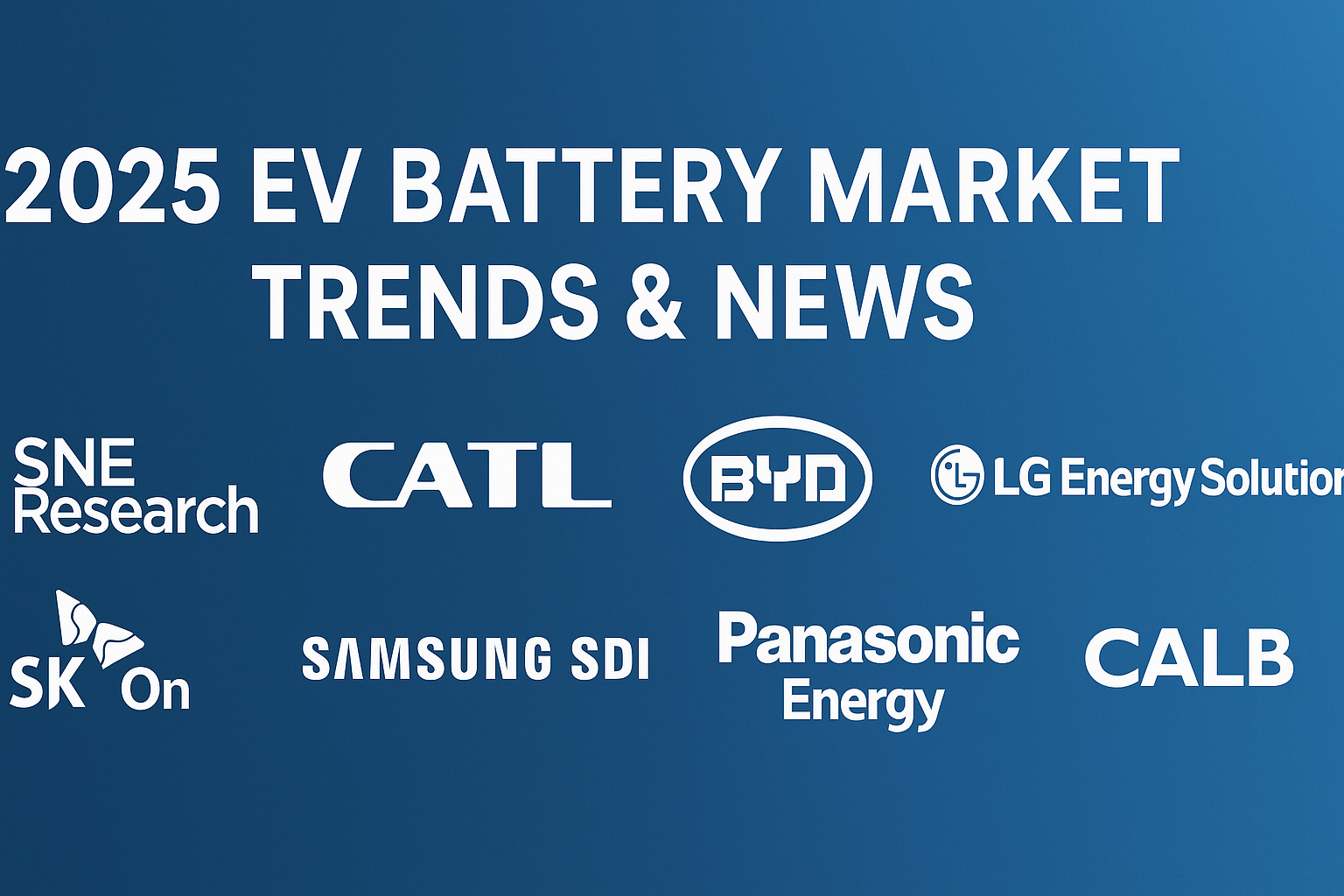
The “big 7” battery makers—CATL, BYD, LGES, SK On, Samsung SDI, Panasonic, and CALB—are shaping a dynamic industry landscape. China leads, Korea adapts, and Japan stabilizes. The outcome of this race will define the future of mobility and the energy transition.
Reference Information
🔢 Market Trends & Statistics
- SNE Research – Global EV Battery Market Share, H1 2025 https://www.sneresearch.com/ Example article (Electrive)
- IEA – Global EV Outlook 2025 https://www.iea.org/reports/global-ev-outlook-2025
- BloombergNEF – Battery Market Long-Term Outlook, Q2 2025 https://about.bnef.com/blog/ev-battery-forecast-2025/
🏭 Company Trends & Strategic Announcements
CATL
- CATL SuperTech Day 2025 (Sodium-ion battery and Shenxing 2.0 launch) https://www.catl.com/en/news/742.html
- IPO filing and funding plan for CATL’s Hungary factory (May 2025) https://www.hkexnews.hk/
BYD
- BYD European expansion (Hungary and Turkey factories) https://www.reuters.com/business/autos-transportation/byd-build-ev-plant-hungary-2025/ https://www.reuters.com/world/china/byd-eyes-ev-factory-turkey-2025/
LG Energy Solution
- LGES Q1 2025 earnings report and LFP/ESS strategy https://news.lgensol.com/en/pressroom/
SK On
- SK On receives investment from Qatar Investment Authority & IPO update https://pulsenews.co.kr/view.php?sc=30800021&year=2025&no=502422 https://www.kedglobal.com/sk-on/newsView/ked202507030023
Samsung SDI
- Joint venture with GM for EV battery production (June 2025) https://www.samsungsdi.com/sdi-news/ev-battery-gm-jv-2025.html
Panasonic Energy
- Panasonic De Soto factory launch and new Tesla cell development https://news.panasonic.com/global/press/en240705-1
CALB
- CALB Portugal factory progress (February 2025) https://www.cnbc.com/2025/02/15/calb-europe-expansion-ev-batteries.html
- CALB announces U-shaped battery design (March 2025) https://www.eetimes.com/calb-u-battery-design-2025/