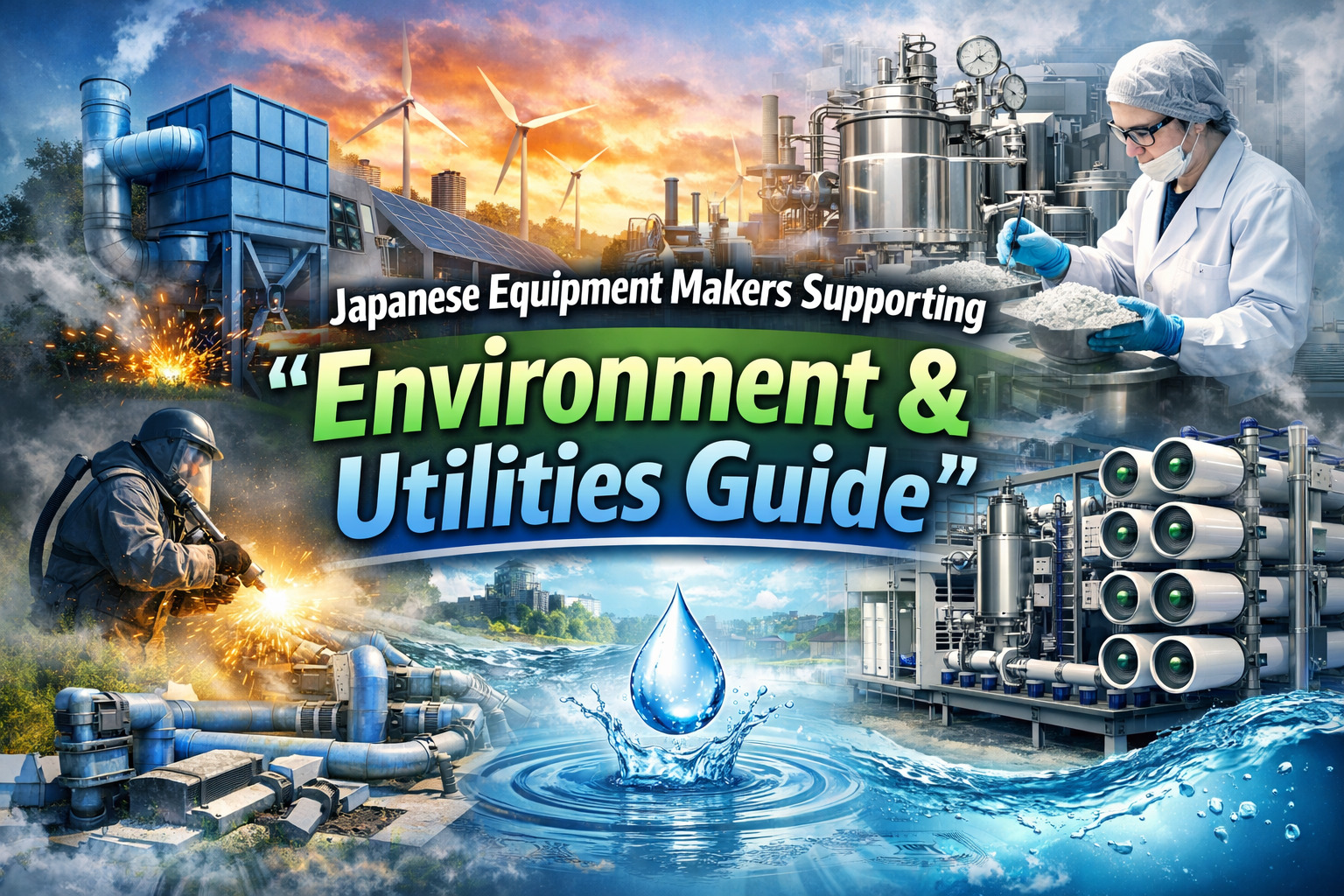
A Practical Guide to Japanese OEMs Supporting Environmental & Utility Systems
In European manufacturing, the reason to invest in environmental equipment is no longer “compliance only.” Poor air conditions caused by dust or mist directly affect health and safety, but they also drive unplanned downtime, defects, audit findings, and even hiring and retention—essentially, factory operations as a whole. In recent years, industries such as battery materials, chemicals, food, and pharmaceuticals have also seen more sophisticated handling of powders and water. As a result, air and water quality increasingly determine product quality and overall uptime.
In this article, I introduce Japanese equipment manufacturers through four lenses: air and powder, in-process dust generation, and water treatment.
1. AMANO — Capturing Dust and Mist at the Source
AMANO’s environmental business is built around “air environment equipment,” represented by dust collectors and mist collectors, while also covering adjacent areas related to powder handling. Even when a shop-floor complaint looks simple—“the factory gets dirty” or “the work is tough”—the root causes are often not. Dust sources may be scattered across multiple points; dust characteristics can be complex (fine, sticky, hygroscopic, combustible, etc.); and airflow can be disturbed by ventilation constraints or conveying requirements. In these situations, AMANO’s core concept—capturing dust and mist at the source—becomes highly effective.
In machining, grinding, welding, mixing, bag opening, and material charging, dust and mist appear at many different points. What matters is not merely selecting a collector, but defining where to capture, in which airflow direction, and how to capture. Hood geometry, duct routing, required airflow, pressure loss, filter selection, pulse/cleaning method, and dust recovery approach (including how the collection container is handled) must work together. Only when these design elements “mesh” does an air environment truly perform in practice.
Across Europe, there is also a growing preference to avoid “excess airflow,” driven by safety requirements including ATEX, as well as electricity cost and CO₂ reduction pressures. In other words, the goal is not simply to increase airflow for capture, but to reliably capture with the minimum necessary airflow, while reducing pressure loss (power) and maintenance burden. Manufacturers like AMANO—who treat air environment equipment as factory infrastructure—are often good partners when you want to improve multiple emission points across a line, standardize solutions for several sources, or reduce shop-floor complaints in a measurable way.
Finally, one of the most important things to check during evaluation is not only “collection performance,” but also “operation.” Filter replacement frequency and accessibility, how collected dust is handled (how exposure is reduced), differential pressure monitoring, abnormal-response procedures, and preventive maintenance design—all of these strongly influence satisfaction after commissioning.
Reference (official site):
https://www.amano.co.jp/en/business/environment
2. Hosokawa Micron — Balancing Powder Processing and the Surrounding Environment
Hosokawa Micron is a globally recognized manufacturer in powder processing equipment such as milling, classification, mixing, and granulation. Even in European plants—especially in industries where “powder defines quality” (battery materials, chemicals, food, pharmaceuticals)—equipment that looks like a “mill” or “mixer” often carries broader challenges: charging, adhesion, agglomeration, moisture, wear, dust explosion risk, cross-contamination, cleanability, and yield loss. Hosokawa Micron’s strength lies in approaching these issues from powder characteristics first, and then integrating process design, operational reality, and the surrounding environment into one discussion.
In powder operations, optimizing a single machine is often not enough. Leakage at upstream/downstream interfaces, dispersion during charging/discharging, and time losses from cleaning or product changeover can prevent the line from running smoothly. That is why the role-sharing between enclosure/isolation (containment) and “right-sized” ventilation and dust collection becomes critical. Should the process be sealed? Should capture be local? Or should both be applied? Fine powders readily travel with airflow and creep into unexpected areas; sticky powders can adhere inside ducts and cause clogging; combustible powders require safety-by-design as a baseline. In powder-heavy industries, embedding these powder characteristics as “design conditions” is essential.
Another point that cannot be ignored is how easily “quality” and “operation” become trade-offs. Tighter particle-size control can demand more severe operating conditions; better cleanability can increase structural complexity and impact changeover time and maintainability. A powder-processing specialist like Hosokawa Micron is well suited for factories that want to protect product quality while also engineering for real-world operation—changeover, cleaning, recovery rate, losses, and operator exposure.
In Europe, when powder handling drives the need for environmental equipment, it is often lower risk—and higher ROI—to discuss whether the system “works as a process” together with the powder processing equipment, rather than installing environmental equipment in isolation. When selecting a partner, it’s important to look beyond standalone specs and evaluate how they translate powder characteristics into design, and how they support tuning after start-up.
Reference (official site):
https://www.hosokawamicron.co.jp/en
3. FUJI Manufacturing — Controlling Dust Generation Inside Blast Equipment
Surface treatment processes such as shot blasting and sand blasting are critical steps that influence product quality, yet they also tend to generate dust, abrasive media, and wear particles simultaneously. This makes them a frequent source of issues on both work environment and equipment uptime. FUJI Manufacturing focuses on blasting equipment itself, with strengths in internal airflow design, dust collection, and abrasive circulation/separation—essentially, “dust generation control inside the machine.”
The difficulty of blasting is that it is not a simple case of “stronger dust collection is better.” Dust must be reliably extracted, while abrasives must be efficiently recovered and recirculated; processing variation must be minimized; visibility and operability must be maintained; and consumable replacement must not destroy uptime. In short, internal phenomena must be engineered to match “process stability” and “maintenance reality,” otherwise the shop-floor burden rises quickly.
For example, if separation accuracy is weak, residual dust can affect product surfaces and also make the equipment dirtier. If consumables are difficult to replace, downtime increases and the process becomes a bottleneck. If dust collection is insufficient, visibility deteriorates; if it is excessive, energy costs rise. Because these factors interact, blasting is a representative case of environmental control that must be completed inside a single piece of process equipment. A manufacturer like FUJI—optimizing process equipment together with dust collection and circulation—can be highly valuable when blasting is either a quality driver or a key uptime constraint.
In European plants, blasting is often reconsidered during capacity expansion or line renewal. At that point, it is practical to compare not only “throughput,” but also dust control, abrasive circulation, maintenance cycle, consumables availability, and safety design on the same table. Blasting may look like a standalone CAPEX decision, but it influences uptime, quality, safety, and maintenance workload—making it “process infrastructure” in practice.
Reference (official site):
https://www.fujimfg.co.jp/english
4. Water Treatment (Industrial Water / Pure Water / Wastewater) and the “Membrane & Filtration” Ecosystem
Air and powder are visible issues, but in Europe it is not uncommon for water treatment to become a question of “uptime,” not just “environmental compliance.” In some regions, securing water is difficult; wastewater regulations and audit requirements can be strict. In addition, in battery materials, chemicals, pharmaceuticals, and food, water quality can directly impact product quality and yield. Water treatment can therefore become a utility that supports “factories that do not stop,” at the same level of importance as HVAC or electrical systems.
A useful approach is to understand the factory’s total water flow before focusing on treatment methods. Where and how much water is used, what water quality is required, where wastewater is generated, and how far reuse/recovery can go—these questions define the best investment and OPEX balance. Cooling water, boiler feedwater, cleaning water, process water, pure water, and wastewater each require different specifications, and therefore different optimization points. Recently, recovery/reuse, wastewater reduction, and even near-zero discharge concepts have become more common considerations. In many cases, membrane and filtration technologies—RO/UF, filtration, ion exchange, electrodeionization—are the core options supporting a factory’s water strategy.
Two Japanese companies frequently considered in this domain are Kurita and Organo. Kurita is often evaluated in the context of industrial water and wastewater solutions and operational improvement, while Organo is clearly positioned across industrial water treatment through ultrapure water—making it especially relevant in industries where water quality is effectively product quality. Importantly, water treatment does not end at installation. Long-term operation design—chemicals, filters, membrane replacement, cleaning, monitoring items, and abnormal response—determines the real value by reducing the plant’s operational burden.
In Europe, water treatment is best addressed proactively—not only “after a discharge issue occurs,” but in preparation for future production increases, material/process changes, new line start-ups, audit requirements, and rising water/energy costs. Water can be postponed until “later,” but when the problem finally surfaces, it can hit factory operations directly.
References (official sites):