

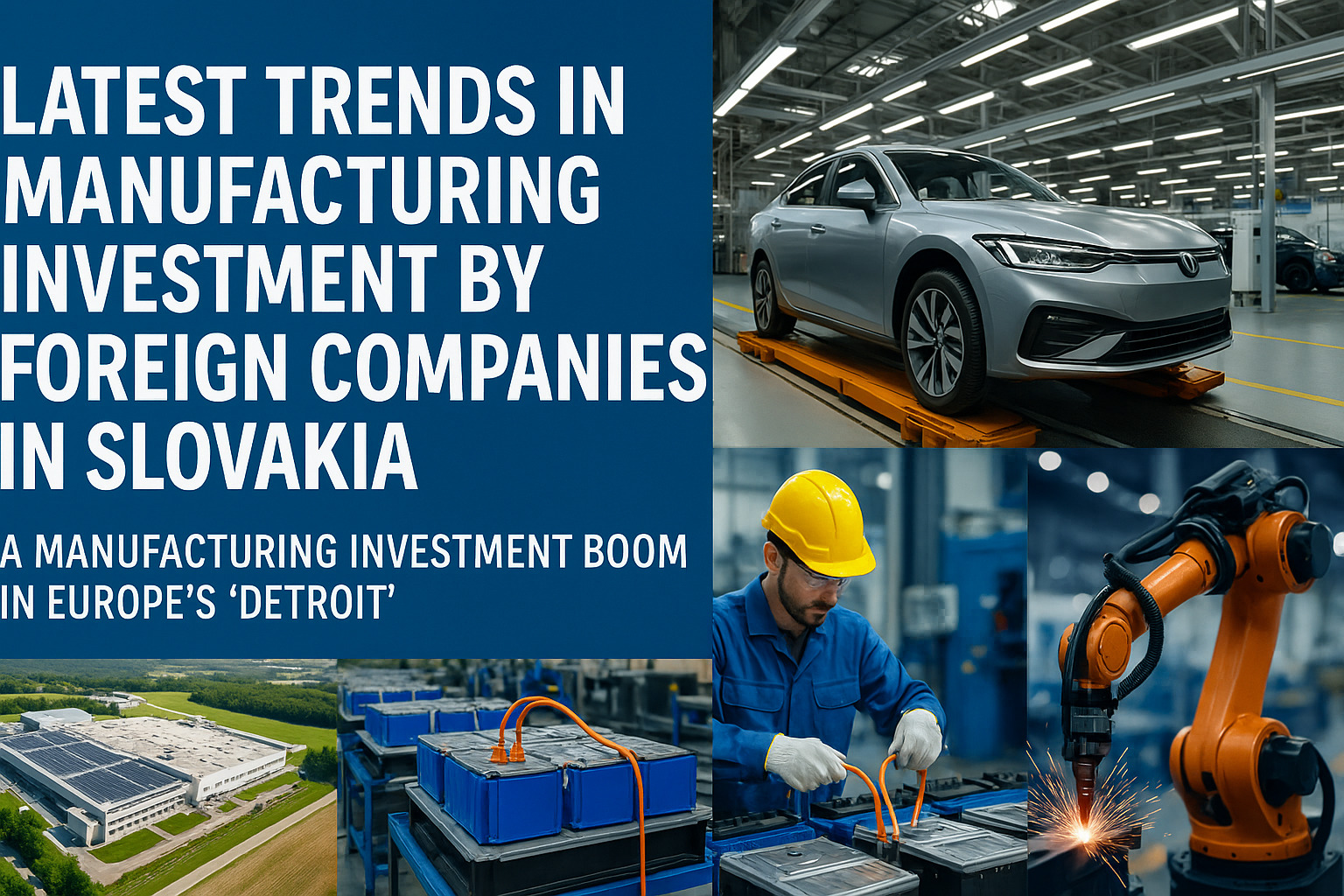
Introduction: A Manufacturing Investment Boom in Europe’s “Detroit”
Located in Central Europe, Slovakia produces over one million cars per year and is known as the country with the highest per-capita automobile production in the world. Its geographical advantage, skilled labor force, well-developed supply chains, and generous investment incentives from the government and the EU make it an extremely attractive destination for foreign manufacturers. In recent years, global companies from Europe, the U.S., Korea, and China have been actively establishing and expanding manufacturing bases, with particularly large-scale investment projects in the green economy, including electric vehicles (EVs) and battery industries. The following outlines the major manufacturing investments, highlighting industry-specific trends, investment scales, job creation, company names, locations, and government support measures.
Automotive Industry: Large-Scale Projects Including Eastern Europe’s First EV Plant
Slovakia, often called the “Detroit of Europe,” has a thriving automotive industry. To maintain this advantage into the era of next-generation mobility, large-scale investments in electric vehicles (EVs) are accelerating. The most significant development is the plan by Swedish automaker Volvo Cars, owned by Chinese capital, to build a new EV assembly plant near Košice in eastern Slovakia. With a total investment of €1.2 billion, the project aims to produce around 250,000 electric vehicles annually and create approximately 3,300 new jobs. In 2024, the European Commission formally approved €267 million in investment aid from the Slovak government (about 22% of the total investment), and infrastructure development at the Valaliky industrial park, the construction site, is being fast-tracked as a national project. The plant is scheduled to begin mass production in early 2027, becoming the first full car production base in eastern Slovakia, expected to serve as both a driver of the regional economy and a symbol of the industry’s electrification shift.
Korean automakers are also accelerating their EV strategies in Slovakia. Kia Motors of South Korea invested approximately €108 million to modernize its production line in Žilina (operating since 2004) to support electric vehicles and began local production of the new EV4 for the European market in August 2025. With this, the Žilina plant has established a system to manufacture 100% electric models alongside hybrids and combustion-engine cars. Kia Europe CEO Marc Hedrich described it as “an important step showcasing flexibility and technological capability in European operations.” The plant, which employs about 3,700 workers and operates with over 600 robots, boasts an annual production capacity of 350,000 units. The launch of EV4 production demonstrates Slovakia’s evolution into a “comprehensive powertrain manufacturing nation.”
In addition, UK-based Jaguar Land Rover (part of India’s Tata Motors) announced that its assembly plant in Nitra, opened in 2019, will begin producing electric models by 2030. Including existing Japanese manufacturers (such as Mitsubishi, operating an engine plant under Nissan), Slovakia’s automotive industry is steadily advancing electrification. Despite a population of just 5.5 million, Slovakia remains one of the world’s leading vehicle exporters, with companies renewing their facilities to maintain that status.
Battery Value Chain: Gigafactories and Related Investments
Along with the expansion of EV production, large-scale investments in battery plants are underway to establish local supply systems for automotive batteries. The most notable project is the construction of a new battery gigafactory through a joint venture between China’s Gotion High-Tech and Slovak startup InoBat. With an investment of €1.2 billion, this project is the second-largest in Slovak history. Located in the developing industrial park in Šurany, Nitra County, the plant will initially produce 20 GWh of lithium-ion batteries annually, with plans to expand to 60 GWh in the future. Mass production is targeted for early 2027, with about 1,200 jobs expected to be created. As European countries strive to reduce reliance on Asia and foster domestic EV battery industries, Slovakia aims to strengthen its position in the supply chain by attracting this massive investment.
The Slovak government has designated the project as a “strategic investment,” applying a new special legislation to simplify and expedite permitting procedures. In March 2025, a strategic investment certificate was issued for the Šurany industrial park, streamlining processes such as environmental assessments and construction permits. Additionally, public data indicates that €150 million in subsidies and €64 million in tax relief will be provided, demonstrating the government’s proactive approach to attracting the investment. While some local residents have raised environmental concerns, the government positions the project as a “strategic investment contributing to the green economy,” aiming to balance regional development and industrial modernization.
In the battery sector, other investments are also emerging. China’s Xinquan Group, through its local automotive interior component subsidiary, is investing €8.4 million to expand production at the Petrovany industrial park in Prešov County. The expansion is expected to create up to 300 new jobs, strengthening export-oriented production of interior components for automakers. While not batteries themselves, this expansion exemplifies the local growth of EV-related component production, likely contributing to supply chains for the new Volvo EV plant.
Parts and Electronics: Korean and Western Firms Expand and Diversify
Beyond complete vehicles and batteries, foreign investments span various manufacturing sectors. South Korea’s auto parts giant Hyundai Mobis signed an investment agreement with the Slovak government in October 2024, announcing a plan to invest about $257 million (€257 million) to build a new plant and expand existing facilities. Specifically, a new plant in Nováky (central-west Slovakia) will manufacture EV power electric systems (electric drive modules), while its existing facility in Žilina (northwest) will expand production of EV brake systems. The new Nováky plant, covering approximately 100,000 square meters, is scheduled to start operations in the second half of 2025, with capacity to supply 300,000 EV drive systems annually. This investment strengthens Hyundai Mobis’ position in the European EV market and expands its supply network to major automakers. The Nováky site, a former coal mining area closed in 2023, will also see about 281 new jobs created, contributing to regional transformation.
U.S. electronics manufacturer Amphenol, the world’s second-largest connector maker, is also expanding in Slovakia. Through its subsidiary Conec Slovakia, the company is enhancing production capacity for industrial and hybrid connectors at its plant in Giraltovce, Prešov Region. In January 2025, the Slovak government approved investment aid of €1.25 million in the form of income tax relief for the project. While total investment details were not disclosed, the expansion is expected to create up to 523 new jobs. Supplying to sectors such as telecommunications, energy, medical, and aerospace, the project will strengthen high-value-added component production in Slovakia’s eastern regions, helping to diversify industry and reduce unemployment.
In western Slovakia, Dutch EMS giant Neways is investing €28 million to build a new factory in Nová Dubnica, Trenčín County. Groundbreaking took place in October 2024, and the facility will produce electronic components for medical devices and automobiles (such as high-performance cable assemblies and charging modules), creating over 1,000 jobs. Operations are slated to begin in September 2025, with plans to supply advanced products like parts for ASML’s semiconductor equipment, EV charging modules, and high-precision microscopes. Already one of Slovakia’s top electronics manufacturers, Neways’ expansion underscores the growing cluster of high-tech industries from semiconductors to EV-related fields.
Traditional industries are also seeing green investment projects. Austrian-owned paper and packaging giant Mondi is replacing an old boiler at its pulp and paper mill in Ružomberok with a biomass power plant. Announced in August 2025, the €120 million project aims for completion in 2027. Once operational, the plant will raise the mill’s energy self-sufficiency from 75% to 90%, while reducing nitrogen oxide (NOx) emissions by 50% and particulate matter by up to 83%. Supported by the EU’s Modernization Fund, the project also plans to expand regional district heating supply and reduce waste, marking a significant step toward sustainability in traditional industries.
Government Support and Strategic Goals: Toward Green Economy and High-Tech Attraction
Behind these investments lies Slovakia’s active industrial policy and strategic investment promotion. The country maintains a flat corporate tax rate of 21% while offering subsidies or tax relief covering 25–35% of investment amounts depending on region. For instance, the aforementioned Volvo EV plant received EU-approved aid of about €267 million (22% of the total investment), equivalent to about €81,000 per job created. Such generous incentives are rare in Western Europe, and additional EU regional development funds are being directed to areas like Košice in eastern Slovakia, intensifying competition to attract projects.
The strategic focus is on the transition to a green economy. With the EU’s ban on sales of new gasoline and diesel cars from 2035 in sight, electrification of the automotive industry (EVs and batteries) is a top priority. The Slovak government has designated the Volvo project a national strategic investment for its contribution to e-mobility transition, extending strong support to related component and battery makers as well. Beyond automotive, Slovakia is also pushing decarbonization of heavy industries. For example, U.S. Steel Košice received €300 million in EU recovery funds to support a €1 billion project to replace blast furnaces with electric arc furnaces, expected to reduce CO2 emissions by over 3 million tons annually by 2026.
Looking ahead, Slovakia is also aiming to attract and develop the semiconductor industry. Under the EU Chips Act, a €1.5 billion support framework was announced for Slovakia in 2025, earmarked for potential construction of a 300mm wafer plant. Although no large-scale semiconductor plants are currently located in the country, neighboring Czechia saw U.S.-based Onsemi commit $2 billion to expand advanced power semiconductor production in 2024. As Central and Eastern Europe gain attention as a new hub for semiconductors, Slovakia is laying the foundation with initiatives like the establishment of the “SK Chips Competence Center.” Whether Slovakia can secure a major semiconductor investment will be a key point of attention.
Conclusion: Diversification and Upgrading of Slovakia’s Manufacturing Sector
As seen, since 2025 Slovakia has attracted a diverse array of investment projects by non-Japanese companies. In the core emerging sectors of electric vehicles and batteries, manufacturers from China, Europe, the U.S., and Korea are setting up bases, while traditional industries are reinvesting with a focus on green technologies. These developments are bringing thousands of jobs and cutting-edge technologies to Slovakia, contributing to regional economic balance and the EU’s climate goals. Continuing to grow as a Central European hub, Slovakia will remain a strategic production base for global companies.
Reference:
https://newmobility.news/2025/08/21/kia-starts-ev4-production-in-car-factory-magnet-slovakia/
https://www.mhsr.sk/en/top/the-surany-industrial-park-received-a-strategic-investment-certificate
https://evertiq.com/news/56586
https://www.reuters.com/technology/onsemi-invest-up-2-bln-czech-semiconductor-plant-2024-06-19
https://www.skchipscompetencecentre.sk/
Planning a factory project in Europe?
We help companies find partners and engineering support for manufacturing projects in Europe.


