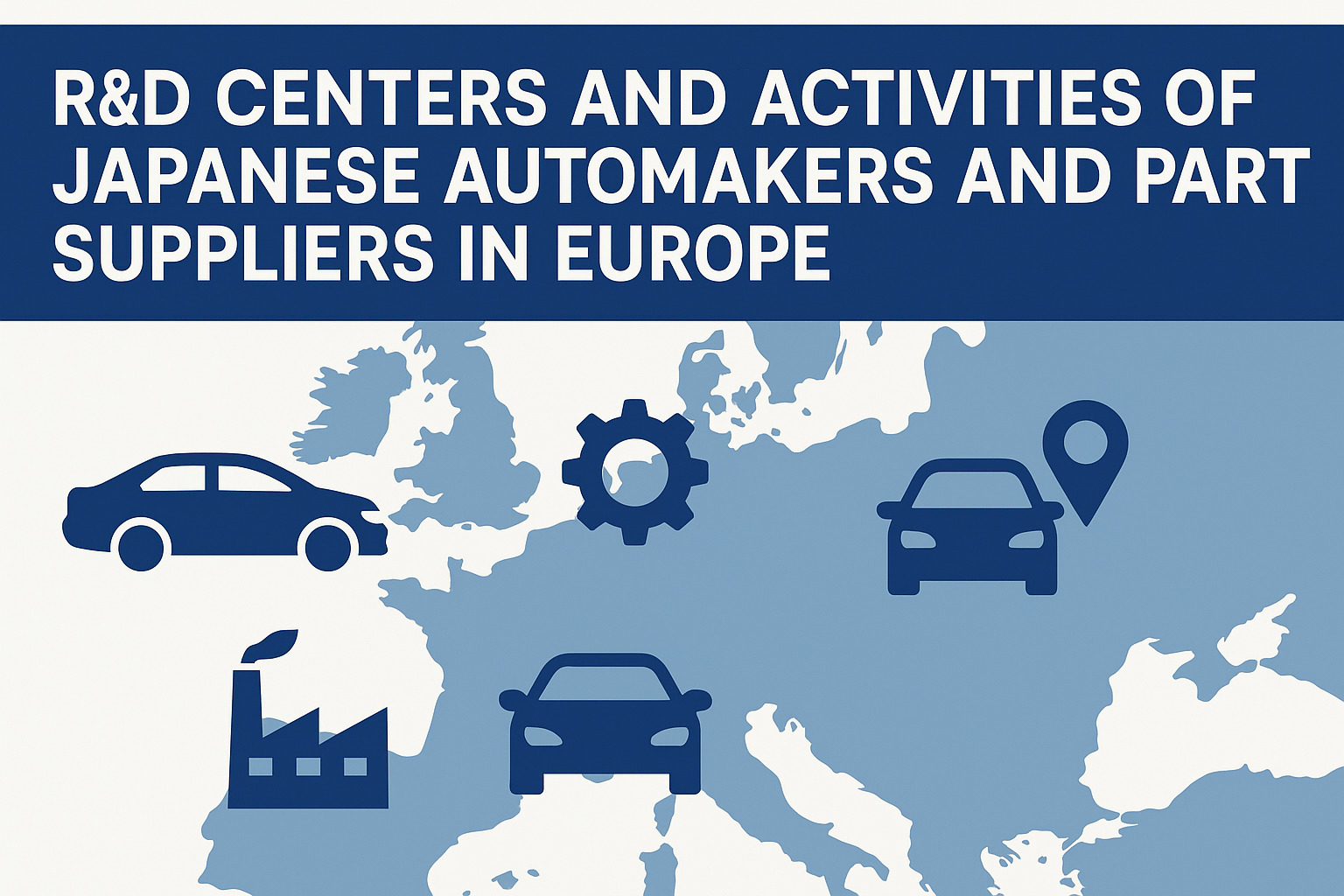
In the European automotive market, Japanese automakers (OEMs) and Tier1 suppliers hold a significant presence. Companies such as Toyota and Nissan have not only established local production but also set up research and development (R&D) centers across Europe, engaging in vehicle development tailored to local needs and advanced technology research. For example, Toyota has invested more than €11 billion in Europe since 1990 and expanded its operations to employ around 90,000 people. Nissan also employs over 17,000 people across Europe in design, R&D, production, and sales, making it one of the most extensively localized foreign automakers. The large-scale local structures reflect a recognition that R&D in Europe is essential to respond quickly to increasingly diverse customer needs and environmental regulations. This article introduces the R&D centers and activities of Japanese automakers and Tier1 suppliers in Europe, highlighting their unique features and latest developments.
European R&D Centers of Japanese Automakers
Toyota Motor Corporation: A Development Network Anchored in Belgium
Toyota operates a large-scale R&D center in Zaventem, near Brussels, Belgium — the Toyota Motor Europe Technical Centre. Established in 1987, the center is responsible for body design and major component development and evaluation for vehicles aimed at the European market. Between 2006 and 2007, the facility underwent significant expansion, doubling its floor area to strengthen its capabilities. This Belgian R&D hub handles body engineering for all Toyota vehicles produced in Europe, as well as evaluation of diesel engines for the European market, serving as the core of Toyota’s product development capabilities in the region.
In addition, Toyota runs its advanced design studio ED² (ED-Square) in Nice, France, for innovative concepts and designs for the European market, while also maintaining design support capabilities in Zaventem. Toyota Gazoo Racing Europe (formerly Toyota Motorsport GmbH) in Cologne, Germany, serves as the motorsports development and production hub, providing feedback from racing into mass production vehicles. With Belgium at its core, Toyota has built a network of R&D centers across Western Europe to drive product development and technology tailored to European needs and regulations.
Nissan Motor Corporation: Development System Behind Europe-Born Bestsellers
Nissan has also established its own development structure in Europe. At its core is the Nissan Technical Centre Europe (NTCE) in Cranfield, UK, founded in 1988. For over 30 years, NTCE has led the design and development of vehicles for Europe. Initially created to support the Sunderland plant, NTCE has since contributed to the development of 32 models, including the crossover best-seller Qashqai and the electric Leaf, and has grown into a global R&D hub with more than 1,000 engineers.
NTCE also spearheaded the development of the European-spec Leaf, incorporating local customer requirements into product design and overseeing production ramp-up. Beyond its UK headquarters, NTCE has expanded to Barcelona (Spain), Belgium, Bonn (Germany), and London (Nissan Design Europe in Paddington), covering vehicle, powertrain, and quality research as well as design creation. Nissan also has its AMIEO headquarters in Montigny, France, overseeing Europe, India, the Middle East, and Africa. This development framework enables Nissan to deliver attractive, competitive vehicles aligned with local production capabilities in Europe.
Honda Motor Co., Ltd.: Pursuing Advanced Technologies in Germany and the UK
Honda maintains R&D centers in Germany and the UK, pursuing local development and advanced research. Near Frankfurt in Offenbach, “Honda R&D Europe (Deutschland) GmbH” conducts research for cars, motorcycles, and power products. This site places particular emphasis on renewable energy and hydrogen technologies, having recently implemented a smart company project with solar power, battery storage, and hydrogen production systems. These efforts demonstrate Honda’s commitment to renewable energy utilization and a CO₂-free hydrogen society.
Also in Offenbach, the Honda Research Institute Europe focuses on AI and robotics as future technologies. In the UK, although the Swindon plant was closed, Honda maintains “Honda R&D Europe (U.K.) Ltd.” in Reading, which continues vehicle and component development tailored to European standards. Honda has accelerated its electrification strategy in Europe, achieving full hybrid/EV lineups by 2022 — ahead of schedule. Through such R&D activities, Honda continues to project its presence and technological influence in the European market.
Mazda Motor Corporation: Adapting Technologies and Designs from Germany
Although smaller in scale than other Japanese OEMs, Mazda operates its European R&D center in Oberursel, near Frankfurt, Germany. Established in 1990 as Mazda Research Europe (MRE), the facility conducts market research, product development, and provides technical feedback to Mazda headquarters. The site also functions as one of Mazda’s three global design studios, generating design concepts inspired by European sensibilities.
While Mazda does not maintain production plants in Europe, its German R&D activities support compliance with EU emission and safety regulations and conduct road testing to enhance product competitiveness. SkyActiv engine technologies, for example, have been evaluated under European driving conditions. Mazda’s European R&D center remains agile and innovative, contributing to unique and appealing models for European customers.
Other Japanese OEMs: Leveraging Alliances
Mitsubishi Motors and Suzuki also maintain European bases. Mitsubishi operates a design studio and R&D center near Frankfurt in Trebur, focusing on design development for the European market. However, recent product development has largely been conducted within the Renault-Nissan-Mitsubishi alliance, limiting Mitsubishi’s independent R&D footprint in Europe. Suzuki operates a production plant in Esztergom, Hungary, but has no dedicated R&D center in Europe. Instead, it leverages collaboration with Toyota for hybrid technology introduction, particularly for European models. These examples highlight the diversity in strategies among Japanese OEMs regarding European R&D structures.
European R&D Activities of Japanese Tier1 Suppliers
Denso: From Powertrain to Mobility Software
Denso, a key Toyota Group supplier, operates multiple R&D and technical centers across Europe. One of its major sites is the Aachen Engineering Center (AEC) in Germany, founded in 2005 as Europe’s first diesel fuel injection R&D base. Initially focused on diesel injectors and common rail systems, AEC has expanded into gasoline and hybrid powertrains. In 2010, Denso invested €19.3 million to expand the facility with advanced test benches and ECU labs.
In line with stricter European fuel economy and emission standards, Denso has strengthened its development of electrified powertrains and thermal management systems, collaborating closely with European automakers. Additionally, Denso’s site in Eching near Munich provides engineering and customer support.
In 2018, Denso opened the Helsinki Innovation Lab in Espoo, Finland, to collaborate with startups and universities on mobility software and smart city solutions. This is Denso’s only European base for mobility software, leveraging local 5G and autonomous testing fields. Furthermore, Denso has production bases in the Czech Republic and Hungary for HVAC and powertrain components, with engineering teams handling prototyping and customer support.
Aisin: Electrification Development Anchored in Belgium
Aisin, a leading transmission manufacturer, runs its AW Technical Center Europe in Braine-l’Alleud, Belgium. The center develops automatic transmissions and navigation systems, working closely with its adjacent Mons plant. Aisin supplies transmissions not only to Toyota but also to European OEMs like BMW and Volvo, making local technical centers crucial for adaptation. With electrification gaining momentum, Aisin is also developing e-Axles and electrified driveline systems, through ventures like BluE Nexus. The Belgian R&D center plays a central role in adapting these next-generation technologies to European requirements. Aisin also maintains production plants in the Czech Republic, UK, and Turkey, linking manufacturing with R&D for efficient local support.
NSK: Next-Generation Bearings at European Technical Centers
NSK, a global leader in bearings and steering systems, operates European Technology Centres in Newark (UK), Ratingen (Germany), and Kielce (Poland), employing around 200 engineers. These sites conduct new product design, material research, application-specific testing, and technical support for local customers.
The centers test automotive hub bearings under simulated loads, develop high-speed bearings for EV motors, and run EPS testing labs in Ratingen to support European OEMs. Using advanced FEA and simulation, NSK provides tailored designs that enhance performance and comply with European standards, reinforcing its technological leadership in bearings.
Other Major Suppliers: Bridgestone and Electrical Component Makers
Bridgestone has operated its European Technical Center in Rome since the 1960s, developing tires tailored to European road conditions and customer preferences. The center combines advanced simulations with real-world testing and recently invested in driving simulators to speed up development cycles.
Wiring harness suppliers like Yazaki and Sumitomo Electric run European technical centers in Germany, developing harnesses and wiring modules for European OEMs. Nippon Seiki has a UK-based development site for automotive display meters. Hitachi Astemo established an R&D base in Munich to advance powertrain and ADAS technologies. Marelli (created through the merger of Calsonic Kansei and Magneti Marelli) combines R&D strengths from Italy, Germany, and the UK, making it a global supplier with integrated expertise from Japan and Europe.
Long-Term Role in the EV and CASE Era
Europe is leading global automotive innovation in CASE (Connected, Autonomous, Shared, Electrified), and Japanese R&D centers in the region play critical roles in responding to these shifts. In electrification, Japanese OEMs have accelerated their strategies to meet EU CO₂ regulations and the 2035 ban on new ICE vehicles. Honda has already achieved full electrification of its lineup, while Nissan continues to expand EVs and hybrids such as e-POWER. Toyota has unveiled plans to expand its BEV lineup, including the bZ4X, and even established local production of fuel cell modules in Belgium. Toyota also partners on FCV pilot projects, including Hilux prototypes in the UK.
In autonomous and connected technologies, Nissan has conducted public road trials of ProPILOT in the UK and participated in robotaxi demonstrations in France. Toyota has invested in European AI and mobility startups, while Denso has expanded partnerships in Finland and collaborated with Ceres Power in the UK on solid oxide fuel cells and electrolysers. Such alliances highlight how Japanese companies are integrating into Europe’s innovation ecosystem.
Japanese OEMs and suppliers are also strengthening partnerships with European automakers and tech firms — Toyota and BMW on sports cars and fuel cells, Renault-Nissan-Mitsubishi on platforms, Honda with UK energy companies on EV charging, and Aisin with Bosch on transmissions. These collaborations are shaping future mobility technologies.
Conclusion: Contribution and Outlook
The European R&D centers of Japanese automakers and suppliers are more than local adaptation hubs; they are catalysts for innovation in the wider European automotive industry. By leveraging local talent and collaborating with European partners, they merge Japan’s monozukuri spirit with Europe’s innovation culture. Nissan’s Qashqai set a crossover trend, Toyota’s fuel cell technologies are now used in trains and commercial vehicles, and suppliers like Denso and Aisin have become indispensable partners for European OEMs.
Going forward, these R&D centers will grow in importance as Europe advances toward carbon neutrality and CASE-driven mobility. Japanese expertise in hardware and quality management will complement Europe’s innovation strengths, creating synergies that drive safer, greener, and more advanced mobility solutions. The local presence of Japanese companies will remain key to sustaining this collaborative progress.
Reference
https://global.toyota/en/detail/268937
https://en.wikipedia.org/wiki/Toyota_Motor_Europe
https://www.nissan-global.com/EN/COMPANY/PROFILE/EN_ESTABLISHMENT/EUROPE
https://global.honda/en/about/group/RandD
https://www.insidemazda.co.uk/2018/10/16/mazda-announces-new-european-rd-vice-president/
https://en.wikipedia.org/wiki/Mitsubishi_Motors_Europe
https://www.denso.com/global/en/news/newsroom/2010/100714-01
https://www.enterespoo.fi/success-story/denso-came-espoo-quality-startups-stayed-quality-living
https://en.wikipedia.org/wiki/Aisin
https://www.aisin-europe.com/aisin-europe-s-a
https://www.nsk.com/eu-en/tools-resources/research-and-development/nsk-research-development-centres
https://www.bridgestone.com/corporate/locations/rd
https://global.toyota/en/newsroom/toyota/42383534.html
https://www.toyota-europe.com/brands-and-services/toyota-fuel-cell/fuel-cell-technology