
In recent years, the importance of HVAC systems has been increasing even in manufacturing facilities across Central and Eastern Europe (such as the Czech Republic, Poland, and Hungary). A comfortable and stable indoor environment is essential for improving worker performance and maintaining product quality; however, efficiently air-conditioning (cooling) large factory spaces is not an easy task. Conventional HVAC systems using metal ductwork often lead to uneven temperature distribution, uncomfortable drafts, surface condensation on ducts, as well as internal contamination, difficulty in cleaning, and layout constraints during installation.
This article organizes the typical challenges of factory HVAC systems (especially during cooling operation), examines why conventional approaches struggle to address them, and explains how the Hungarian-developed solution EXANDAIR Textile Air Ducts can improve these issues. The technical principles, key benefits, and implementation steps are outlined below.
Common HVAC Challenges in Manufacturing Facilities (During Cooling Operation)
Manufacturing plants and warehouses commonly face the following HVAC-related challenges.
1) Temperature Imbalance and Draft Discomfort
In large spaces during summer cooling operation, significant temperature differences often occur across different areas, leading to complaints such as “some areas are cool, while others remain hot.” With conventional systems that supply cold air from localized outlets, airflow does not reach the entire space evenly. As a result, areas near air outlets tend to be overcooled, while distant areas do not receive sufficient cooling.
In addition, metal duct systems typically discharge cold air at high velocity from limited outlets. When this airflow directly hits workers, it creates uncomfortable drafts, often described as “too much wind” or “cold air blowing directly on the body.” During cooling operation, such drafts can cause discomfort, health issues, and on-site complaints.
In Central and Eastern Europe, where securing and retaining skilled labor has become a serious challenge, workplace comfort is an increasingly important factor. These HVAC issues affect not only comfort but also labor conditions and productivity.
2) Condensation on Duct Surfaces
During summer cooling, moisture in the air often condenses on the cold surfaces of metal ducts, leading to water droplets. If condensation drips onto equipment or products, it can result in quality and safety risks. This issue is particularly serious in food processing plants, facilities with washing processes, or production areas with strict temperature and humidity control requirements.
Although insulation is often used as a countermeasure, it increases construction costs and may introduce new issues such as contamination or mold growth on the insulation itself.
3) Cleaning and Hygiene Challenges
Dust and contaminants tend to accumulate inside metal ducts, and cleaning them is not easy. Professional cleaning is usually required, and in many cases it is difficult to completely remove internal contamination. In food, pharmaceutical, or clean production environments, maintaining clean air distribution paths is a critical requirement.
4) Layout Constraints and Construction Burden (Including Downtime Costs)
Metal ductwork is heavy and rigid, making installation difficult in facilities with structural constraints or complex layouts. Additional supports and space are required, and relocation or modification during layout changes can be costly.
Moreover, installation often requires scaffolding and heavy equipment. In operating factories, coordinating construction schedules and minimizing production downtime become major challenges. In Central and Eastern Europe, there is a strong demand for short construction periods and minimal manpower, especially when production lines cannot be stopped.
Why Conventional Metal Duct Systems Struggle to Solve These Issues
These challenges stem from structural limitations inherent to metal duct systems:
- Dependence on localized air outlets leads to drafts and uneven cooling
- High thermal conductivity of metal causes surface condensation during cooling
- Internal cleaning is difficult, limiting hygiene control
- Heavy and rigid structures reduce flexibility for retrofits and layout changes
These issues are not simply matters of construction quality, but rather fundamental limitations of the system itself.
Solutions with EXANDAIR Textile Air Ducts
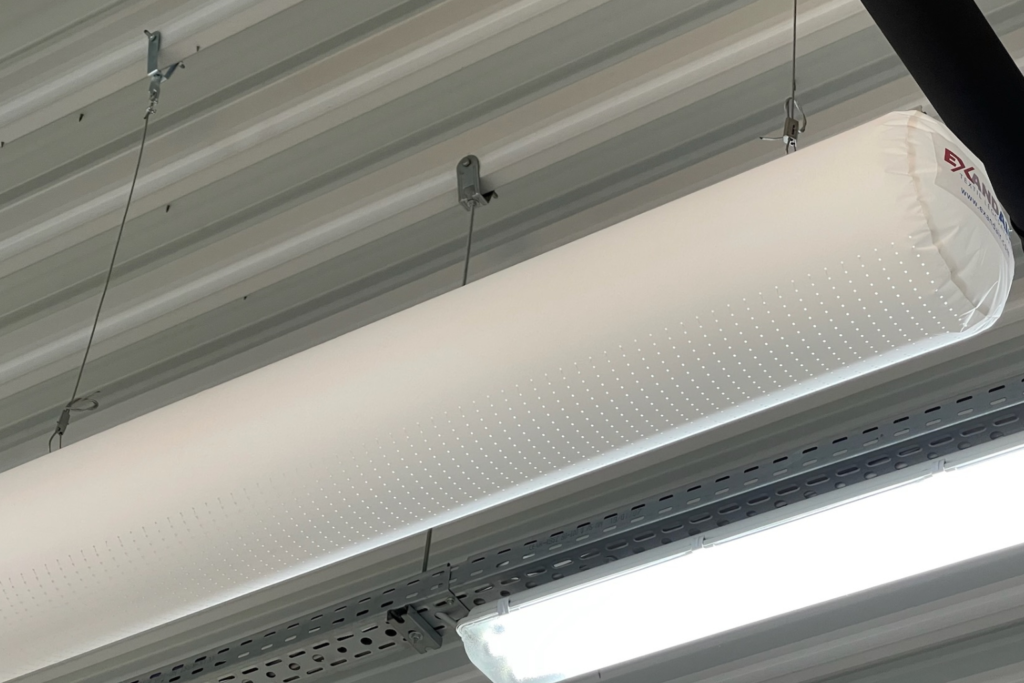
EXANDAIR Textile Air Ducts are fabric-based HVAC ducts. The duct body itself functions as an air diffuser, allowing cool air to be evenly distributed along the entire length of the duct. In Central and Eastern European factories, these systems are typically designed and installed primarily for cooling applications, delivering the following benefits.
1) Simultaneous Improvement of Temperature Balance and Draft Reduction
The key advantage of fabric ducts is their ability to distribute air evenly along the entire duct length. By supplying air across a surface rather than from localized outlets, overall temperature distribution becomes more stable. Strong direct airflow toward workers is minimized, significantly reducing drafts and related discomfort or complaints.
2) Condensation Control with Reduced Dependence on Insulation
Thanks to the fabric material and air diffusion mechanism, textile ducts are less prone to surface condensation compared to metal ducts. In many cases, this allows effective condensation control without heavy reliance on insulation, offering advantages in both performance and installation.
3) Improved Hygiene through Washable Air Distribution Paths
Fabric ducts can be removed and washed, making it easier to maintain clean air distribution paths. This “washable” feature is particularly valuable in facilities where hygiene and contamination control are critical, such as food, pharmaceutical, chemical, and electronics manufacturing. Regular cleaning also helps visualize and standardize hygiene management.
4) Lightweight, Flexible Design and Total Cost Optimization
Fabric ducts are lightweight and relatively easy to install. Even in existing buildings with beams, limited ceiling height, or equipment interference, they can be adapted through flexible shapes and suspension methods, making modifications during layout changes easier.
In operating factories where downtime costs are a major concern, fabric ducts often require less installation labor and shorter construction periods.
In addition, compared to metal ductwork, fabric ducts may reduce total costs in terms of materials, installation, and schedule. By improving temperature balance and reducing drafts, they also help prevent excessive cooling, contributing to optimized energy consumption.
Rather than being “simply cheaper,” fabric ducts should be viewed as a solution that simultaneously improves comfort, quality, hygiene, and operational efficiency while optimizing total cost.
Suitable Applications
EXANDAIR Textile Air Ducts are particularly well suited for the following environments:
- Automotive and parts manufacturing: Large production areas, frequent layout changes, draft complaints
- Electronics, precision, and battery manufacturing: Stable temperature and humidity, dust and hygiene control
- Food and beverage: Condensation prevention, hygiene, washability
- Pharmaceutical and chemical plants: Clean environment, stable conditions, process flexibility
- Warehouses and logistics centers: Large spaces, uniform cooling, worker comfort
Implementation Process
A typical implementation process includes:
- Initial consultation and issue identification (temperature imbalance, drafts, condensation, hygiene, layout constraints, allowable downtime)
- Basic design and cost estimation
- Detailed design (duct size, perforation pattern, suspension method)
- Custom fabrication
- Installation and commissioning
- Operation and maintenance planning (cleaning and replacement)
Conclusion
Manufacturing facilities in Central and Eastern Europe face multiple HVAC challenges, including worker comfort, condensation and hygiene, and the burden of retrofitting systems in operating factories. These issues are difficult to fully address with conventional metal duct systems.
EXANDAIR Textile Air Ducts offer a solution by fundamentally rethinking how airflow is delivered, enabling improvements in temperature balance, draft reduction, hygiene, and operational efficiency.
For facilities struggling with uneven cooling, drafts, condensation, or heavy retrofit requirements, EXANDAIR represents a valuable option for HVAC system upgrades and improvements.